The Disclosure Timeline Is Wrong
The future Chairman of the Joint Chiefs called the phenomenon "real and not visionary or fictitious" in a Secret memo three months before the famous 1947 directive. The timeline is backwards.

In January 1943, Nathan Twining spent nearly a week in a life raft in the South Pacific after the B-17 carrying him ditched at sea. He was rescued, went back to work, and commanded two numbered air forces in combat before the war ended. The Thirteenth in the Solomons. The Fifteenth over Italy and the Balkans. By 1945 he had the Twentieth Air Force and the strategic bombing campaign against Japan.
In 1953 he became Chief of Staff of the United States Air Force. In 1957, Chairman of the Joint Chiefs of Staff, the most senior uniformed officer in the entire United States military.
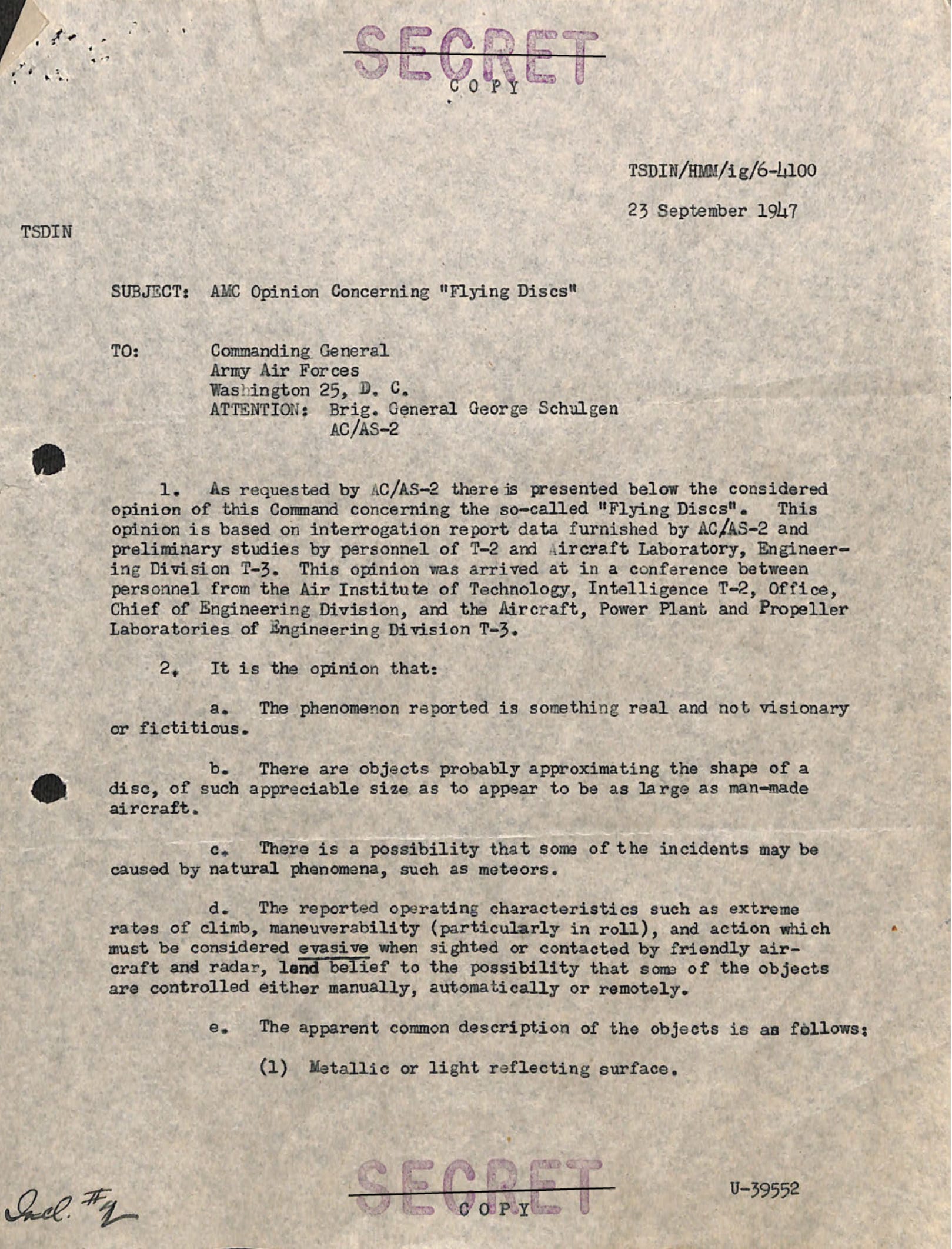
On September 23, 1947, between the combat commands and the Joint Chiefs, Twining was a lieutenant general running the Air Materiel Command at Wright Field in Dayton, Ohio. That day he signed his name to a classified memo and sent it up the chain to the Commanding General of the Army Air Forces in Washington. The subject line read “AMC Opinion Concerning ‘Flying Discs.’”
The operative paragraph:
“It is the opinion that:
a. The phenomenon reported is something real and not visionary or fictitious.
b. There are objects probably approximating the shape of a disc, of such appreciable size as to appear to be as large as man-made aircraft.”
The Twining memo is one of the most cited documents in UAP history. It is almost always treated as a standalone artifact, a single striking quote lifted out of context. It is the opposite of standalone. It is the first move in a documented institutional sequence that ran from September to December 1947, and the famous directive that everyone cites, the one that built private contractors into the foundation of the program, came at the end of that sequence, not the start.
The standard story has the timeline backwards.
My Standing
I spent eight years on active duty in the Navy as an Operations Specialist. Four of those aboard USS Peleliu in TACRON 11 running the Fleet Air Defense Identification Zone in the Pacific. The watch I stood is the same watch the 1947 Air Materiel Command was standing. Identify what’s in the air. Decide friendly, hostile, or unknown. If it’s unknown, escalate. The 1947 packet is what escalation looked like at the strategic level.
What Wright Field Was in 1947
To understand why Twining’s memo carried the weight it did, you have to know what the Air Materiel Command was.
Wright Field was the technical intelligence center of American air power. It was where captured enemy aircraft went to be taken apart. Through 1945 and 1946, under Operation Lusty, the Army Air Forces shipped German jets, rocket engines, radar sets, and airframes to Wright Field for evaluation. The Messerschmitt Me 262. The V-2 components. The Horten flying wings. The German aerospace scientists brought into the country under Project Paperclip were put to work in and around the same facility.
If something flew and the United States wanted to know how, it went to Wright Field. The labs there had spent two solid years reverse-engineering the most advanced aviation technology on earth. That is the institution Twining commanded when he signed the memo. When he wrote that the disc phenomenon was real, he was not a man guessing. He was the man who ran the building where America figured out what was real.
How the Opinion Was Built
Twining’s memo was not a hunch committed to paper. The first paragraph lays out exactly how the opinion was assembled, and the sourcing is the point.
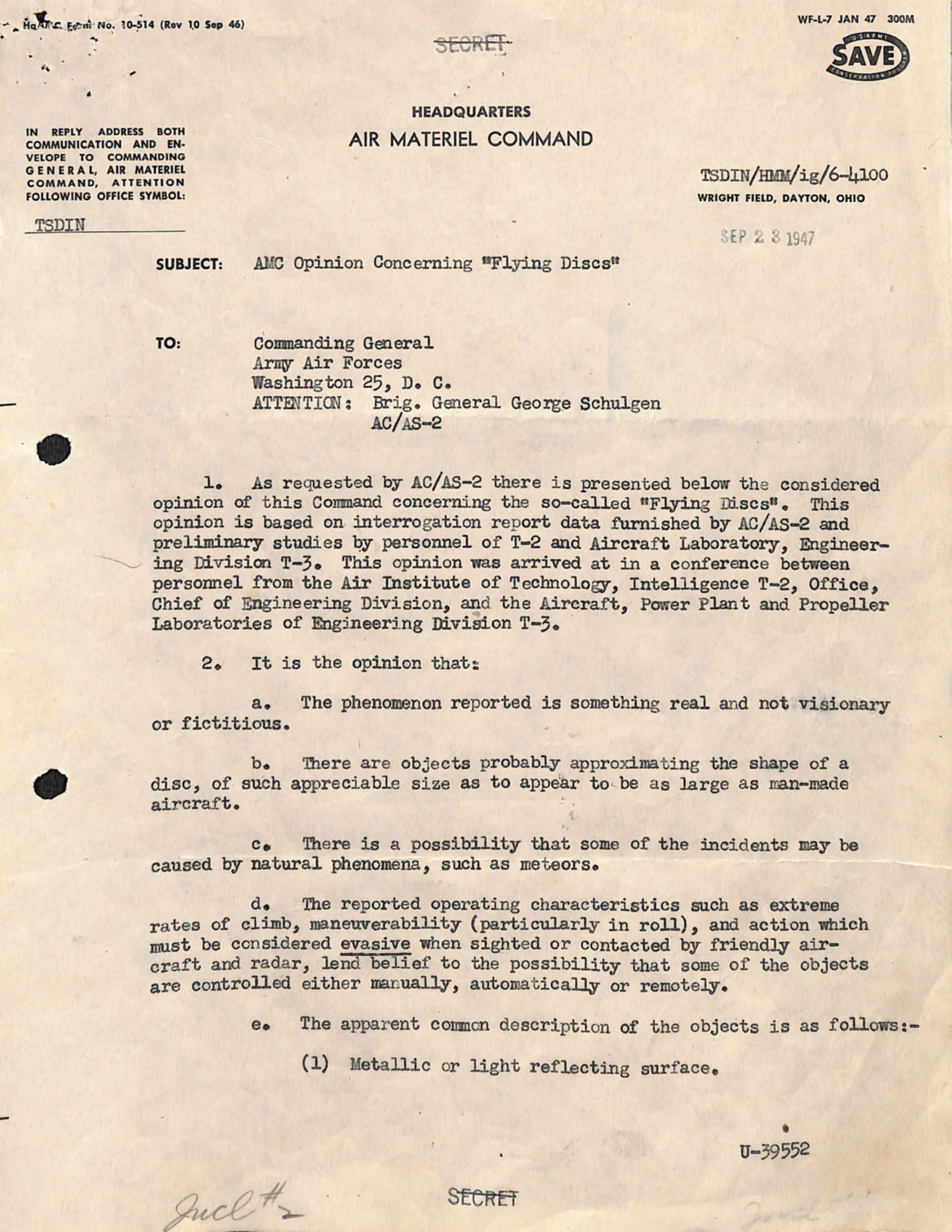
Three streams of data fed it. Interrogation reports furnished by AC/AS-2, the Air Staff intelligence directorate in Washington. Preliminary studies from Twining’s own T-2 intelligence shop. Technical assessment from the Aircraft Laboratory at Engineering Division T-3. The opinion was then finalized in a conference that pulled people from across the Wright Field technical apparatus: the Air Institute of Technology, T-2 Intelligence, the Office of the Chief of Engineering Division, and the Aircraft, Power Plant, and Propeller Laboratories.
That list is every technical exploitation directorate the Army Air Forces had at Wright Field. The same labs that dismantled the Me 262. The same engineers who studied the V-2. Twining was telling Washington that the entire apparatus had looked at the data and reached a consensus. This was not one officer’s read passed up the chain. It was the institution’s finding.
What the Objects Were Doing
Here is the part of the memo that almost never gets quoted, and it is the most concrete evidence in the entire 1947 packet. After stating that the phenomenon was real, Twining’s memo describes what the objects actually did, drawn from the interrogation reports.
Extreme rates of climb. Maneuverability, particularly in roll. Action that must be considered evasive when the objects were sighted or contacted by friendly aircraft and radar. No trail, except in a few instances when the object was apparently operating under high performance. Circular or elliptical in shape, flat on the bottom, domed on top. Formation flights of three to nine objects. Normally no sound, except three instances of a substantial rumbling roar. Level flight speeds normally estimated above 300 knots.
That is not a description of weather balloons or misidentified aircraft. It is a target track. Evasive action when contacted by radar is a behavior, not an optical illusion. Formation flights of three to nine objects is a count, made by trained observers. The man who ran the technical intelligence center of the United States Air Force read those reports, convened his laboratories, and signed his name to the conclusion that the objects were real.
Twining then did the engineering math. Could American industry build something like this? His answer was yes, in principle, with extensive detailed development, capable of roughly 7,000 miles range at subsonic speed. But any such program would be expensive, slow, and would have to run independently of existing projects. And then the line that should stop anyone reading the memo:
“Due consideration must be given the following: (1) The possibility that these objects are of domestic origin, the product of some high security project.”
A lieutenant general writing to the Commanding General of the Army Air Forces, on classified stationery, raising the possibility that the objects were an American black program he had not been read into. He closes the memo by requesting “a complete interchange of data.” Twining is asking Washington to set up a coordinated investigation. He does not yet have the authority to stand one up himself.
That authority would come three months later, in the Craigie directive. The directive was the answer to this memo.
One Day Later: The Loedding Drawing
The day after Twining signed his opinion, a different office at Wright Field sent a technical drawing up the same chain.
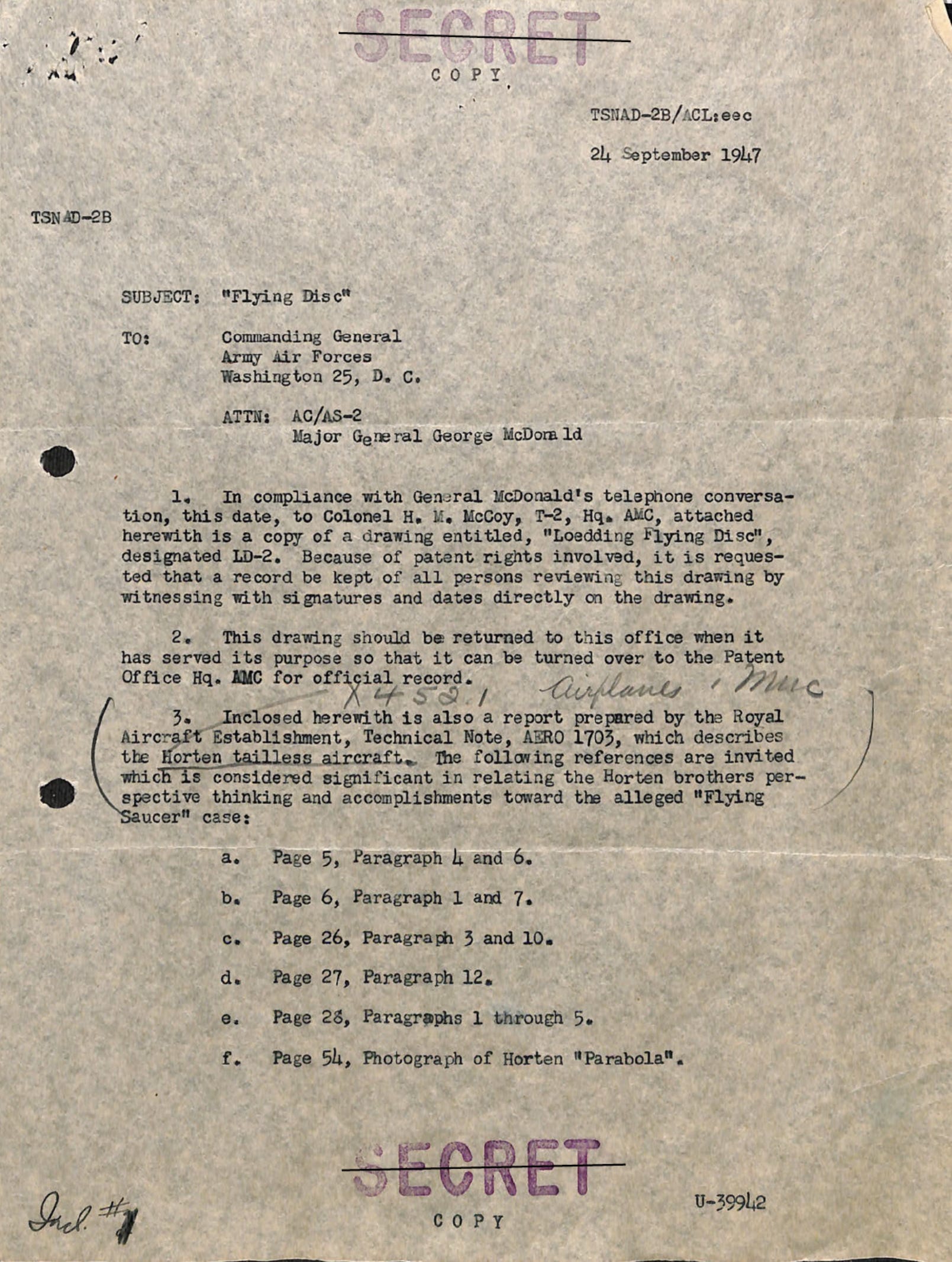
The drawing was titled “Loedding Flying Disc,” designated LD-2. Alfred Loedding was a civilian aeronautical engineer in T-2 at Wright Field, a man with a documented professional interest in low-aspect-ratio and disc-form aircraft. He would go on to become one of the central technical figures in Project Sign. The drawing was being routed up because Major General George McDonald, the Director of Intelligence at AC/AS-2, had asked for it by name.
The cover memo carried one specific instruction: “Because of patent rights involved, it is requested that a record be kept of all persons reviewing this drawing by witnessing with signatures and dates directly on the drawing.”
Patent rights. On a classified drawing of a flying disc. Tracked by signature.
The detail matters because of what it tells you about the office. The same T-2 shop that had just contributed to the opinion that the unexplained disc phenomenon was real was, the next day, routing a classified American disc design with its own intellectual property concerns. The investigation of disc-form objects and the development of disc-form aircraft were not in separate buildings or separate programs. They were the same people, the same week.
The same memo also carried a foreign intelligence note. A U.S. Military Attaché report out of Moscow, dated 9 June 1947, claimed the Soviets were building 1,600 aircraft based directly or indirectly on the German Horten VIII flying-wing design, a 131-foot-wingspan machine, jet-propelled in the Russian version, intended for bomber squadrons. Whether or not that number was accurate, it tells you what Wright Field was worried about. Disc and wing forms, at scale, in Soviet hands. The unexplained phenomenon was being evaluated in that exact threat context.
October: The Phenomenon Gets a File Number
By October 30, 1947, the topic had a permanent home in the filing system. Air Force Headquarters opened index entry 0009, subject “Flying Saucer - Phenomena,” filed under decimal 350.09. The summary line read “Intelligence Requirements on Flying Saucer Type Aircraft.”
The Army decimal filing system was not arbitrary. The 350 series was Intelligence. It held foreign capability assessments, order of battle reports, attaché traffic. Assigning the phenomenon a 350.09 number with a standing “intelligence requirements” heading meant the Air Staff had reclassified it from a news event into a recurring intelligence target, the same bureaucratic category as tracking a foreign weapons program.
Bureaucracies do not open permanent file numbers for things they expect to go away. Ninety days after the summer 1947 sightings, the phenomenon had a file number and a requirements heading. It was now part of the permanent intelligence workload.
December 19: McCoy Sends the Package Up
By the third week of December, enough material had accumulated at Wright Field to justify a formal transmittal to the top. On December 19, 1947, Colonel H.M. McCoy, Twining’s Chief of Intelligence at the Air Materiel Command, sent a packet of reports directly to the Chief of Staff of the United States Air Force.
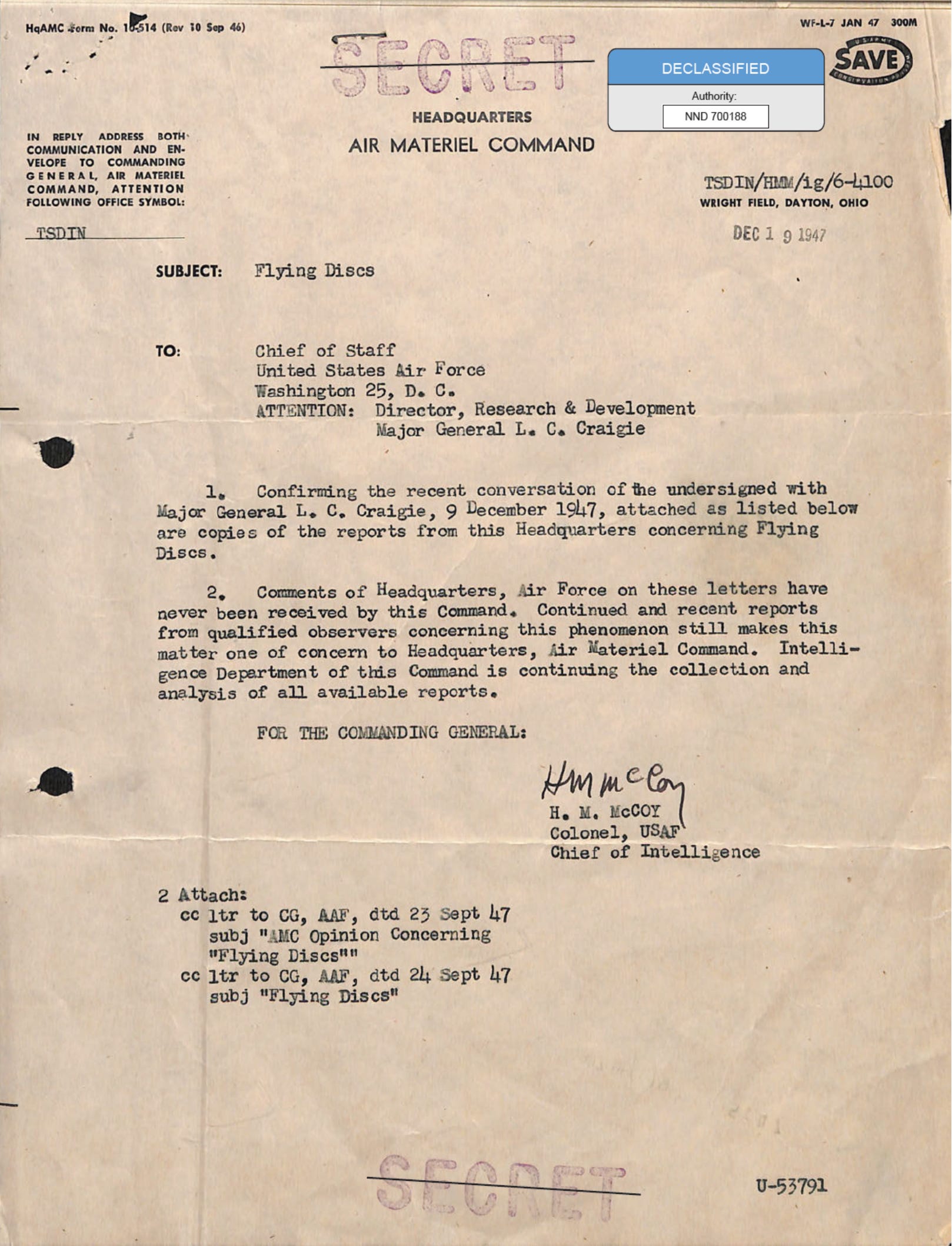
McCoy’s cover note is one paragraph, and every clause in it is doing work:
“Continued and recent reports from qualified observers concerning this phenomenon still makes this matter one of concern to Headquarters, Air Materiel Command. Intelligence Department of this Command is continuing the collection and analysis of all available reports.”
Continued and recent reports. Not a closed case. Qualified observers. Not cranks. Continuing the collection and analysis. An active, ongoing intelligence operation, described in the present tense, by the colonel running it, addressed to the most senior officer in the Air Force. The packet underneath that cover note held the Twining memo, the Loedding material, the file index, AMC’s monitoring of newspaper coverage, and more. Three months of work, bundled and sent to the top.
December 22: The Air Force Says “Film Defects”
Three days after McCoy’s package reached Washington, a separate piece of correspondence went the other direction, back down the chain to California.
The subject was a set of photographs. In November 1946, Mrs. Mary L. Herren had taken pictures near Jefferson, Oregon, that contained marks she thought might be flying discs. The photographs worked their way to the Fourth Air Force intelligence office at Hamilton Field, California, where the intelligence officer, Donald L. Springer, took them seriously enough to forward them to Washington with a note describing Mrs. Herren as “a very reliable source of information.”
This is the reply that came back, signed by a lieutenant colonel for the Chief of Staff:
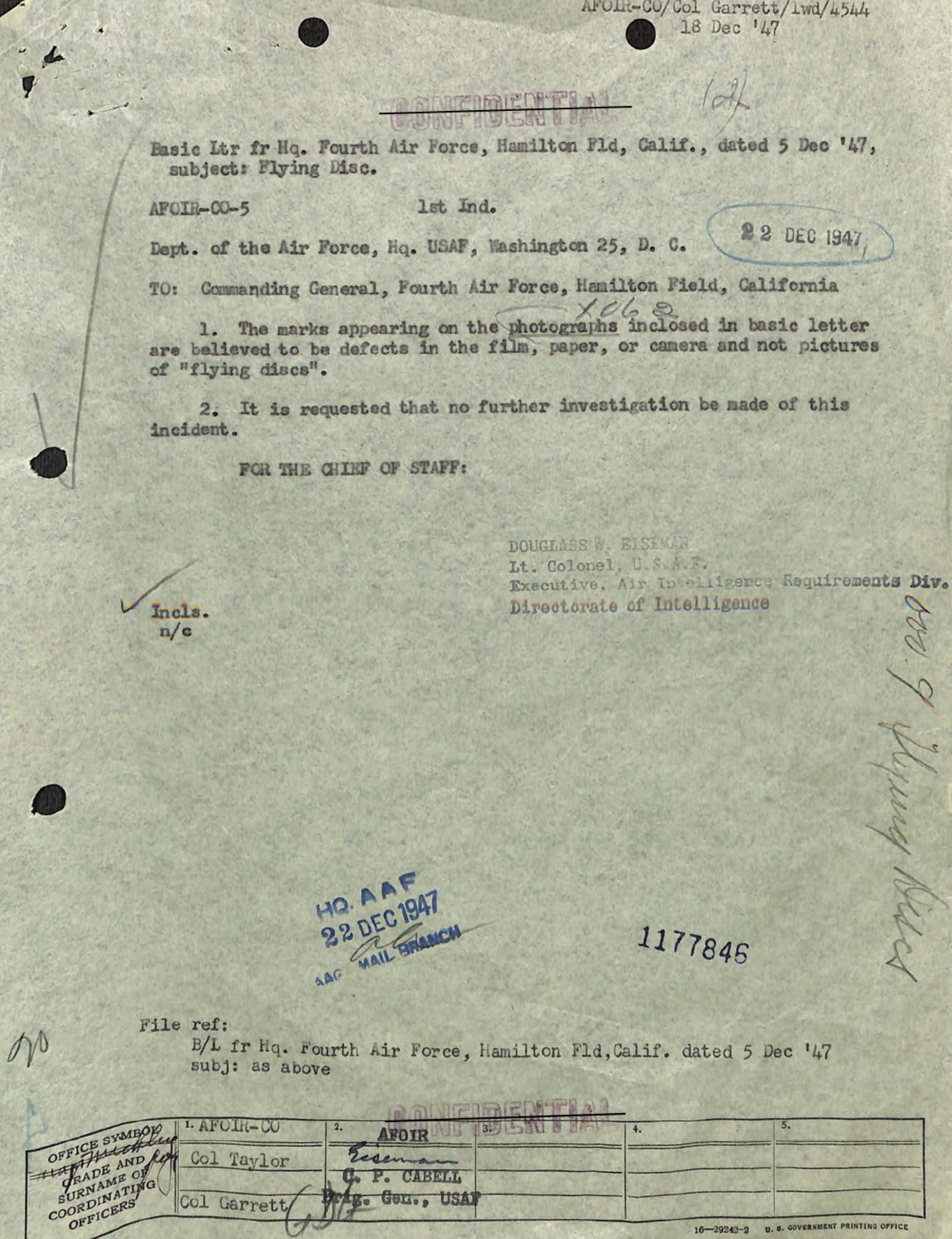
“The marks appearing on the negatives enclosed in basic letter are believed to be defects in the film, paper, or camera and not pictures of ‘flying discs.’
It is requested that no further investigation be made of this incident.”
No analysis was attached. No lab at Wright Field is named as having examined the negatives. The same technical apparatus that three months earlier had convened its laboratories to produce the Twining opinion was not applied here at all. The marks were declared film defects, and the order was to stop.
Hold the two documents side by side. December 19, the institution’s internal record: an active intelligence program, qualified observers, real phenomenon, sent to the Chief of Staff. December 22, the institution’s external posture: film defects, no further investigation, signed for the Chief of Staff. Same office. Same week. Two completely different documents, and the public would only ever have been positioned to see the second kind.
December 30: Craigie Makes It Permanent
Eight days after the Hamilton Field brush-off, Major General L.C. Craigie, the Director of Research and Development, acting by command of the Chief of Staff of the now-independent United States Air Force, issued the directive that ordered the Air Materiel Command to stand up the project that became Project Sign.
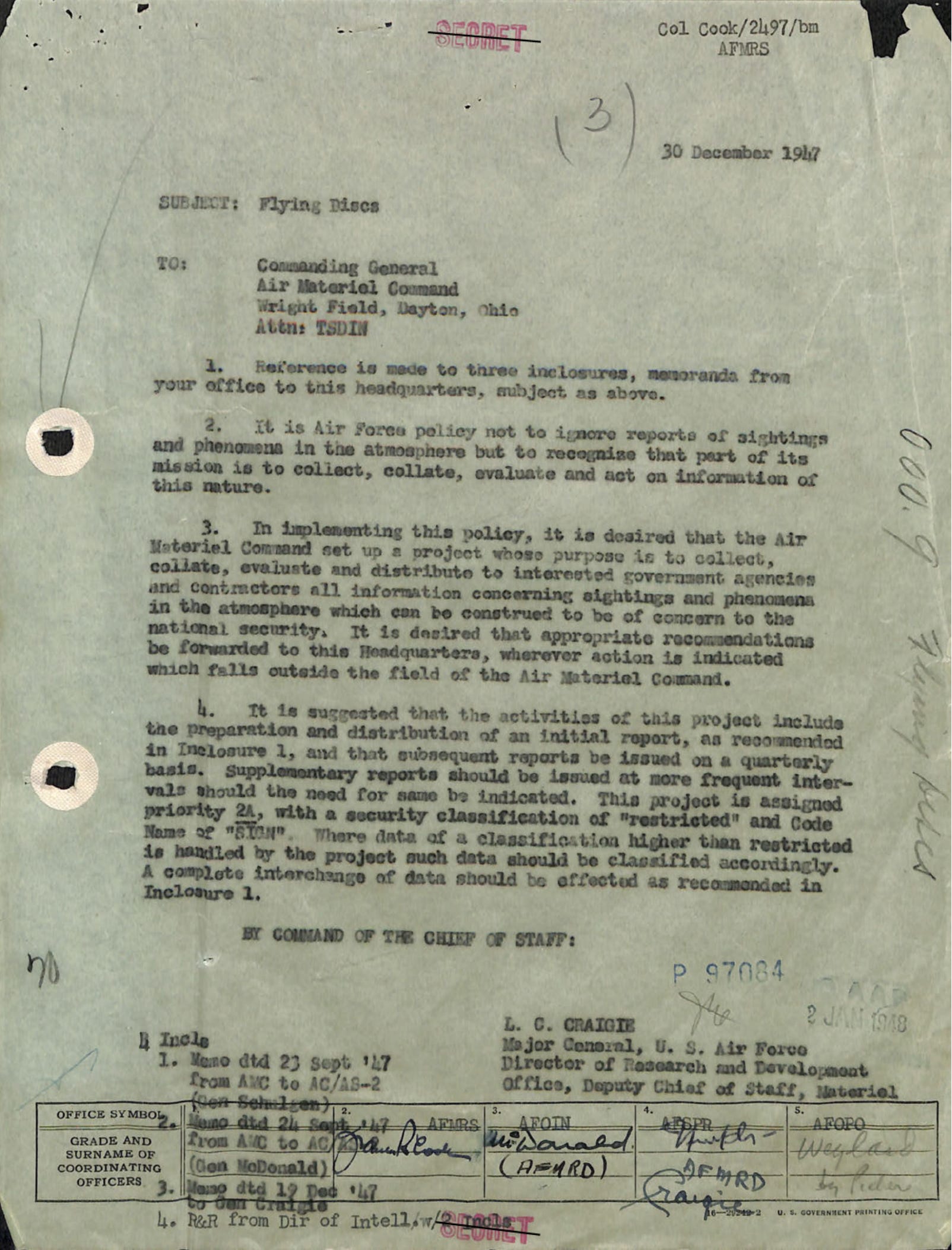
The operative paragraph instructed the new project to “collect, collate, evaluate and distribute to interested government agencies and Contractors all information concerning sightings and phenomena in the atmosphere.” The capitalization of “Contractors” is in the original government document. It is not a transcription choice.
That clause is the structural seed of every UAP classification fight that has happened since. It put private contractors inside the distribution loop of the program on day one, by directive, as standard procedure. Seventy-eight years later, in 2023, the Schumer-Rounds amendment tried to write Congress a tool to reach into exactly that contractor space. The amendment died in conference committee with no recorded opposition. The 1947 directive is still operative.
But notice where the directive sits. It is dated December 30. It is the seventh document in a sequence that opened on September 23 with Twining writing “real and not visionary or fictitious.” Craigie did not start the program. He formalized one that had already been running for three months.
The Sequence, Start to Finish
Lay the seven documents out by date and the shape is unmistakable.
September 23: Twining’s laboratories deliver a formal opinion that the phenomenon is real, with a physical description and an engineering assessment. September 24: the same intelligence shop routes a classified American disc design with a foreign threat note attached. October 30: the Air Staff opens a permanent intelligence file number. Through the fall: the Air Materiel Command monitors press coverage and foreign claims. December 19: the Chief of Intelligence at AMC tells the Chief of Staff in writing that the matter remains active and under analysis. December 22: Air Force Headquarters disposes of a civilian photographic case as film defects with no analysis. December 30: the contractor-distribution directive is signed.
That is not a series of reactive decisions made under pressure. It is a program being assembled, step by step, in under four months. By the time Craigie signed the famous directive, the institution had already decided the phenomenon was real, given it a file number, set up its monitoring, and worked out its public posture.
The standard disclosure narrative assumes the government has spent nearly eight decades trying to figure out what to do about UAP reports. The 1947 packet shows the handling questions were settled in the fall of 1947. What has happened since is not deliberation. It is continuity.
Why This Matters Now
The constitutional question is not about flying discs. It is about whether the architecture the Air Force stood up in 1947, later formalized into permanent operation under the Atomic Energy Act framework and extended through the contractor special access program system, has produced an oversight gap that exceeds what Article I of the Constitution contemplates.
That question is legislatively actionable. It does not require believing anything in particular about UAP. It requires reading the documented chain of institutional decisions from September to December 1947 and asking whether Congress today has the legal reach to compel disclosure from the structure that chain built.
The man who signed the founding opinion went on to chair the Joint Chiefs of Staff. The directive that put contractors in the loop has never been rescinded. The file number is older than almost everyone reading this. Seventy-eight years is enough time to evaluate the result.
Stay sharp.