Not Given to Fantasy
An FBI agent certified the Socorro witness was "not given to fantasy." Five years later the Air Force closed Project Blue Book and said it was done with UFOs. The Bureau's file never closed.

Late in the afternoon of April 24, 1964, Special Agent D. Arthur Byrnes Jr. of the FBI’s Albuquerque field office was finishing routine business at the New Mexico State Police office in Socorro. A radio operator from the Socorro County Sheriff’s office, a man named Nep Lopez, came down the hall. One of the town’s patrolmen had just called in something a mile southwest of the courthouse. An object that had “landed and has taken off.”
Byrnes finished his work, got in his car, and drove out to the site. He was not the only government man who did. By the time he reached the arroyo, New Mexico State Police Sergeant M. S. Chavez was there, along with Socorro County Undersheriff Jim Luckie and State Police Officer Ted Jordan. Within hours an Army captain, Richard Holder, drove down from the Stallion Site at White Sands Missile Range. Within days the Air Force sent its scientific consultant, the Northwestern astronomer J. Allen Hynek. Four institutions converged on one patch of desert over a single sighting.
They did not converge because of a light in the sky. Lights in the sky do not pull the FBI, the Army, the state police, and an Air Force scientist to one arroyo. They converged because there was something on the ground, and because by 1964 each of those institutions had a standing channel for exactly this kind of report and a reflex to feed it.
This piece is about one of those channels. Not the craft. The file the Bureau opened on it, and the fact that the file is still open.
Hoover Wanted the Discs
In July 1947, weeks after the Roswell summer, a memo crossed J. Edgar Hoover’s desk. It asked whether the Bureau would help the Army Air Forces run down the flood of flying disc reports coming in from across the country. Hoover wrote his answer in the margin in his own hand, and the annotation has been quoted ever since. He would assist. But, he wrote, “we must insist upon full access to discs recovered.” Then a grievance, in the same hand: in one case the Army “grabbed it and would not let us have it for cursory examination.”
Read what that note assumes. The Director of the FBI, in the summer of 1947, is not asking whether the discs are real. He is treating recovered discs as physical objects, demanding the right to put his own people on them, and resenting another service for reaching one first. That is not a man humoring a craze. That is a man staking a claim.
The claim became a permanent file. The Bureau opened headquarters file 62-HQ-83894, and field offices fed it for decades. By the time a Socorro patrolman named Lonnie Zamora keyed his radio in 1964, that file had been accumulating flying disc material for seventeen years. Socorro did not begin the Bureau’s involvement. It was one serial dropped into a file that was already old.
Standing
I spent eight years on active duty in the Navy as an Operations Specialist, four of them aboard USS Peleliu in TACRON 11, running the Fleet Air Defense Identification Zone in the Pacific. The work is contact resolution. Something appears in the airspace you are responsible for, and you decide what it is, friendly, hostile, or unknown, and what you do about it.
The radar was never the hard part. The hard part was the witness. A contact is only as good as the person reporting it and the evidence that backs the account. Half the job is judging reliability under pressure, deciding whether what a watchstander swears he saw squares with what the scope and the physical world will support, and knowing when an unknown has crossed the line from anomaly to something you put in writing and send up the chain.
That judgment is exactly what Byrnes exercised at Socorro. He sized up the witness, he measured the evidence on the ground, and he committed both to the federal record. I have read a great many reports built that way, and written my share. This one is clean. The man who built it knew the difference between a witness you bury and a witness you certify, and he chose to certify.
What Byrnes Put in Writing
The memo is dated May 8, 1964, on the letterhead of the United States Department of Justice, Federal Bureau of Investigation, Albuquerque, New Mexico. The subject line is three flat lines of capitals: UNIDENTIFIED FLYING OBJECT, SOCORRO, NEW MEXICO, APRIL 24, 1964. It is written in the register of a man who documents scenes for a living, and the restraint is the evidence.
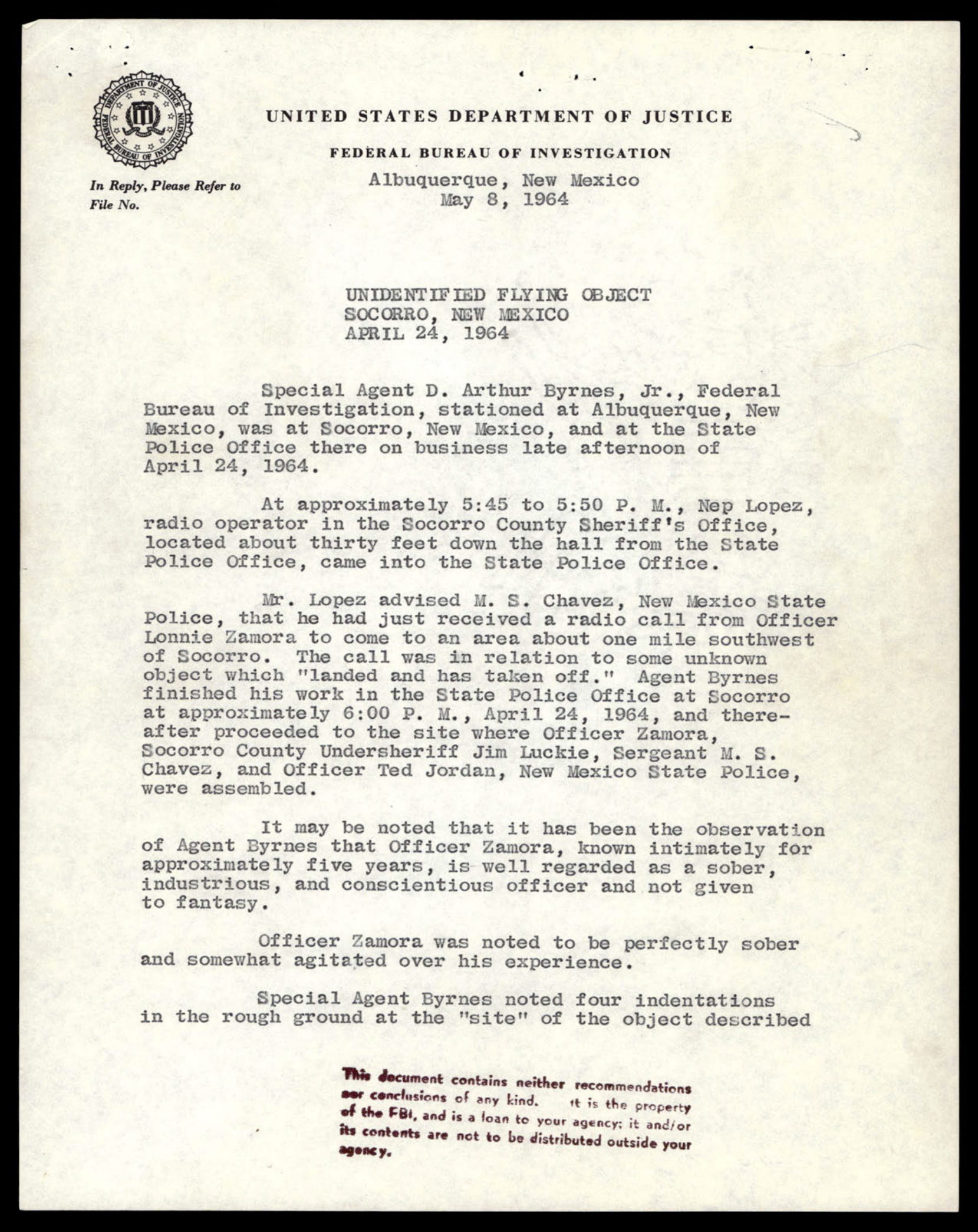
Byrnes measured the ground where the object had stood. He recorded four indentations in the rough earth, each roughly sixteen by six inches, rectangular, about two inches deep, each pressed into the soil at an angle from a center line, as though something had set down on canted supports and shoved the dirt to the far side. Inside the rough rectangle those four marks framed, three burned clumps of grass. Other clumps in the same area, untouched. Three smaller circular marks, smooth, about four inches across, sunk perhaps an eighth of an inch into the sand “as if a jar lid had gently been pushed into the sand.” No dwellings in sight. No other objects. No other person in the area that night.
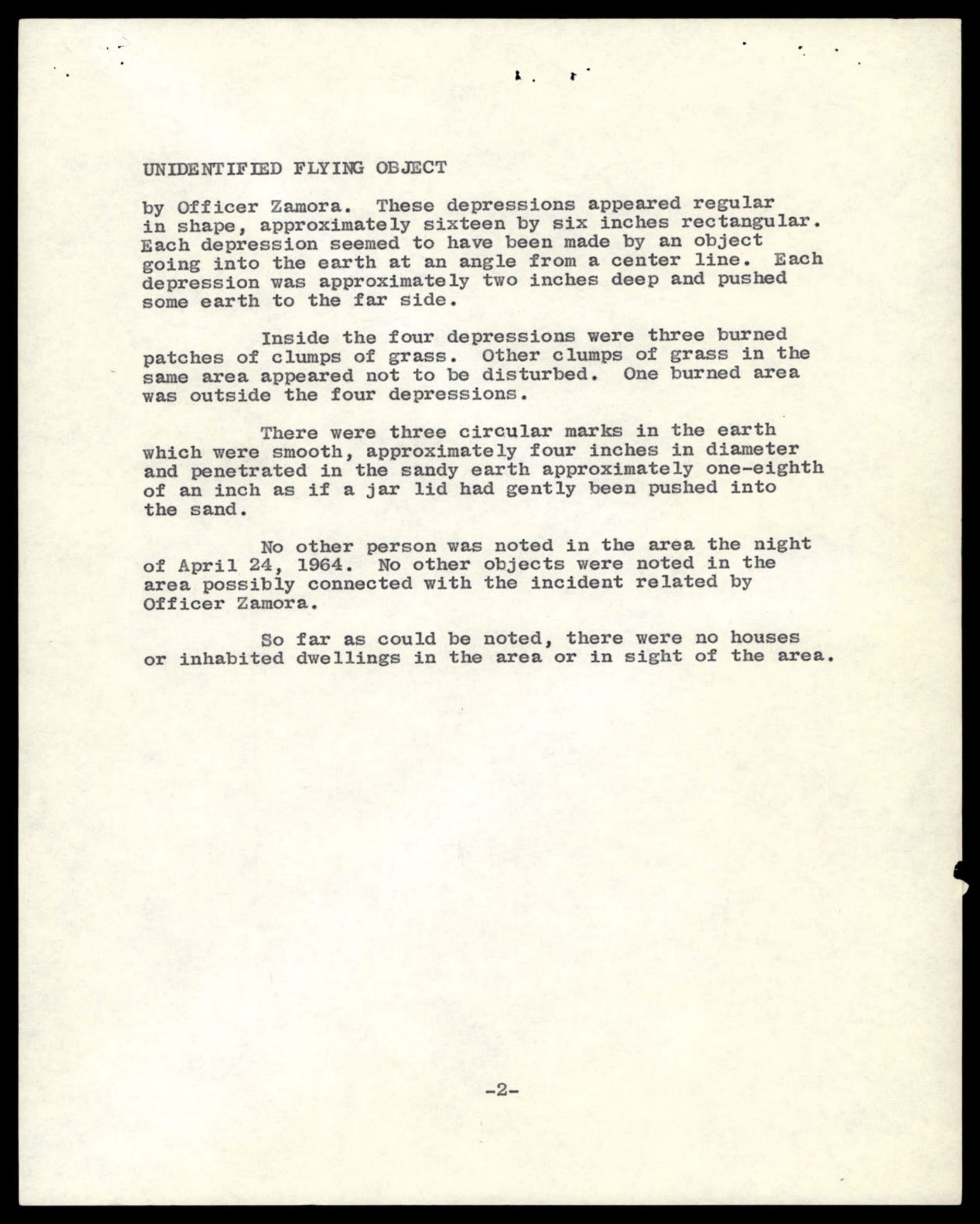
And then the sentence that carries more weight than anything else in the file. Byrnes had known Zamora personally for about five years. He put the assessment in the memo, on the record: the officer “is well regarded as a sober, industrious, and conscientious officer and not given to fantasy,” and on the night in question was “perfectly sober and somewhat agitated over his experience.”
A federal agent does not write “not given to fantasy” about a man he intends to discredit. He writes it about a man he is vouching for. Byrnes was spending his own credibility, in writing, in a document bound for a permanent Bureau file, to certify that the witness was reliable and the marks in the dirt were real.
At the bottom of the page sits a block of boilerplate that is easy to skip and worth reading slowly. The document, it says, “contains neither recommendations nor conclusions of the FBI. It is the property of the FBI and is loaned to your agency; it and its contents are not to be distributed outside your agency.” Hold onto that paragraph. It comes back.
What Zamora Reported
The account in the file is Zamora’s own, taken the night of the 24th and into the morning of the 25th. Strip away the mythology that grew around the case in the decades after and read only what the patrolman told the men standing in the arroyo with him that night.
He had been chasing a speeding black Chevrolet south out of town when he heard a roar and saw a flame in the sky to the southwest, bluish and orange, narrow, funnel-shaped, descending slowly. His first thought was not a spacecraft. It was a dynamite shack he knew sat out that way and the chance it had blown. He broke off the chase and fought his patrol car up a steep gravel hill, wheels skidding, three tries before it took the grade.
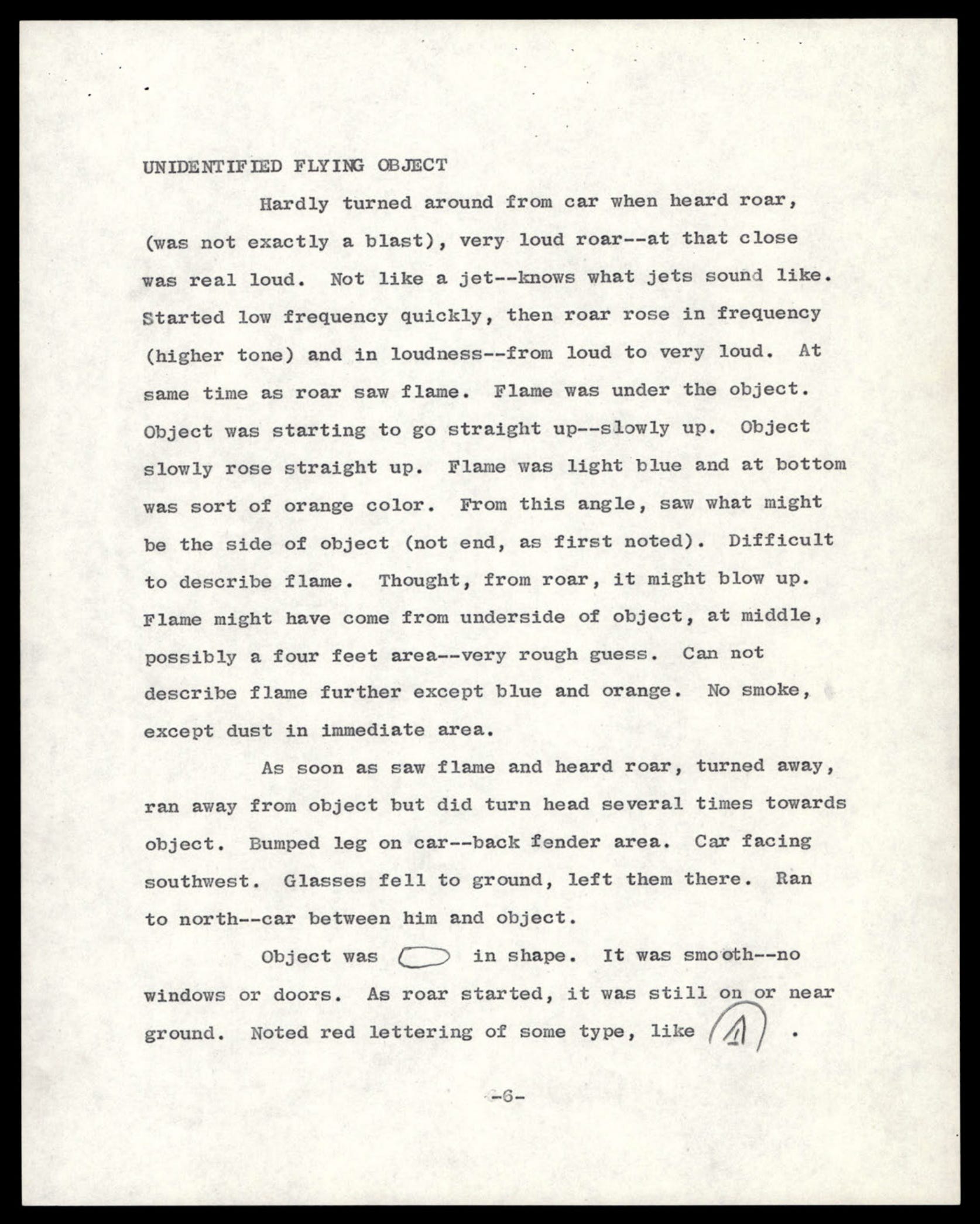
Over the top he saw a shiny object 150 to 200 yards off the road. At first he read it as a car flipped onto its roof, kids who had rolled it, and beside it he saw what looked like two people in white coveralls. One of them turned, looked straight at his patrol car, and seemed to start, as if surprised. He radioed it in as a possible accident and said he was getting out to check.
It was not a car. As he got out he heard two or three loud thumps, like heavy doors slamming a second apart. Then the roar, climbing from low frequency to high, very loud at that range, and Zamora knew jet engines and stated flatly that this was not one. A flame came from underneath the object, light blue going to orange, and the thing rose straight up. Smooth. No windows, no doors he could make out. Aluminum-white against the mesa. And on its side, in red, an insignia he estimated at about two and a half feet high and two feet wide, set in the middle of the body.
He thought it might explode. He ran, struck his leg on the patrol car’s rear fender, lost his glasses in the dirt and left them. He put the car between himself and the object. When he looked back it had risen to about the level of the car, twenty to twenty-five feet, then it cleared the terrain and went off to the southwest. The roar cut out and left a high-to-low whine behind it, and then nothing.
A named officer. On duty. Sober. Vouched for by an FBI agent who had known him five years. Describing a landed object with markings and two occupants, with physical traces in the ground that the agent then measured with his own hands.
Three Agencies, One Arroyo
This is where Socorro stops being a UFO story and becomes a structure story.
Go back to who was standing in that arroyo. Holder, the Army captain, was the up-range commander at the Stallion Site of White Sands Missile Range, and he took his own report that night alongside the FBI’s. Hynek came down for the Air Force through Project Blue Book, walked the site, interviewed Zamora, and came away regarding him as entirely credible. Blue Book worked the case for months and never explained it. It remains in the Air Force’s own records as one of the relatively small number of cases the program formally logged as unidentified.
Now count the channels. The New Mexico State Police on the ground first, through Chavez and Jordan. The FBI documenting and certifying, through Byrnes. The Army taking a parallel report off a strategic missile range, through Holder. The Air Force running a scientific investigation through a standing national program, through Hynek. Four institutions, one patch of desert, one afternoon, and not one of them had to invent a procedure on the spot. Each already had a channel and a form and a file to put this in.
That is the tell. The procedures already existed. In 1947 the Air Force had been directed to collect, collate, evaluate, and distribute reports of the phenomenon, and to route them to interested government agencies and contractors. By 1948 that pipeline had pulled in the Army and the FBI. Socorro in 1964 is what that architecture looked like after sixteen years of operation. Not a scramble. A reflex. Four agencies converging on a landing site because converging on landing sites was, by then, simply what the machinery did.
The Program That Closed, and the One That Didn’t
Five years after Socorro, the public-facing half of that machinery shut down.
In December 1969, on the strength of the University of Colorado’s Condon Report, the Air Force announced the termination of Project Blue Book. The official line was clean and quotable. No UFO reported, investigated, and evaluated by the Air Force had ever given any indication of threat to national security. There was no evidence the sightings represented technology beyond present knowledge, and none that anything seen was extraterrestrial. The government, the announcement made clear, was getting out of the UFO business.
That was the posture. Blue Book was the program the public could see, so closing Blue Book was the act the public could see. The headlines in January 1970 all said the same thing in different fonts. The Air Force is done with flying saucers.
The FBI’s file did not close. There was no announcement, because you cannot hold a press conference shutting down a channel you never advertised. Blue Book had always been the storefront. The Bureau’s 62-HQ-83894 was something else, a permanent records function that predated Blue Book and answered to a different chain entirely. When the storefront closed, the back office kept its lights on.
Set this beside what the 1947 record already showed. In December of that year the Air Force ran two documents through the same headquarters in the same week. One was the internal record, an active intelligence matter, qualified observers, a real phenomenon, sent to the Chief of Staff. The other was the external posture, a civilian’s photographs dismissed as “film defects” with an order that no further investigation be made. Same office, same week, two different faces. The 1969 Blue Book closure is that same maneuver run at the scale of an entire program. The public face announced an ending. The internal capability moved out of view and kept running.
Fifty-Nine Years Later
Move the file forward to September 2023.
A team of contractors was running LiDAR tests on a restricted military range. The lead, a woman with fifteen years on that range, had personally closed the airspace for the tests that morning. At a gate that had never given trouble, the access fob failed three times and opened on the fourth. Just past it, driving to the test site, she looked up and saw a metallic object to the southwest, the length of two or three Blackhawk helicopters nose to tail, with an intense diamond-white light on one end that she compared to looking into the sun. It was nearly hovering, drifting slowly east to west, completely silent. After five to ten seconds it was simply gone from a clear sky. A contractor in the second vehicle saw it too.
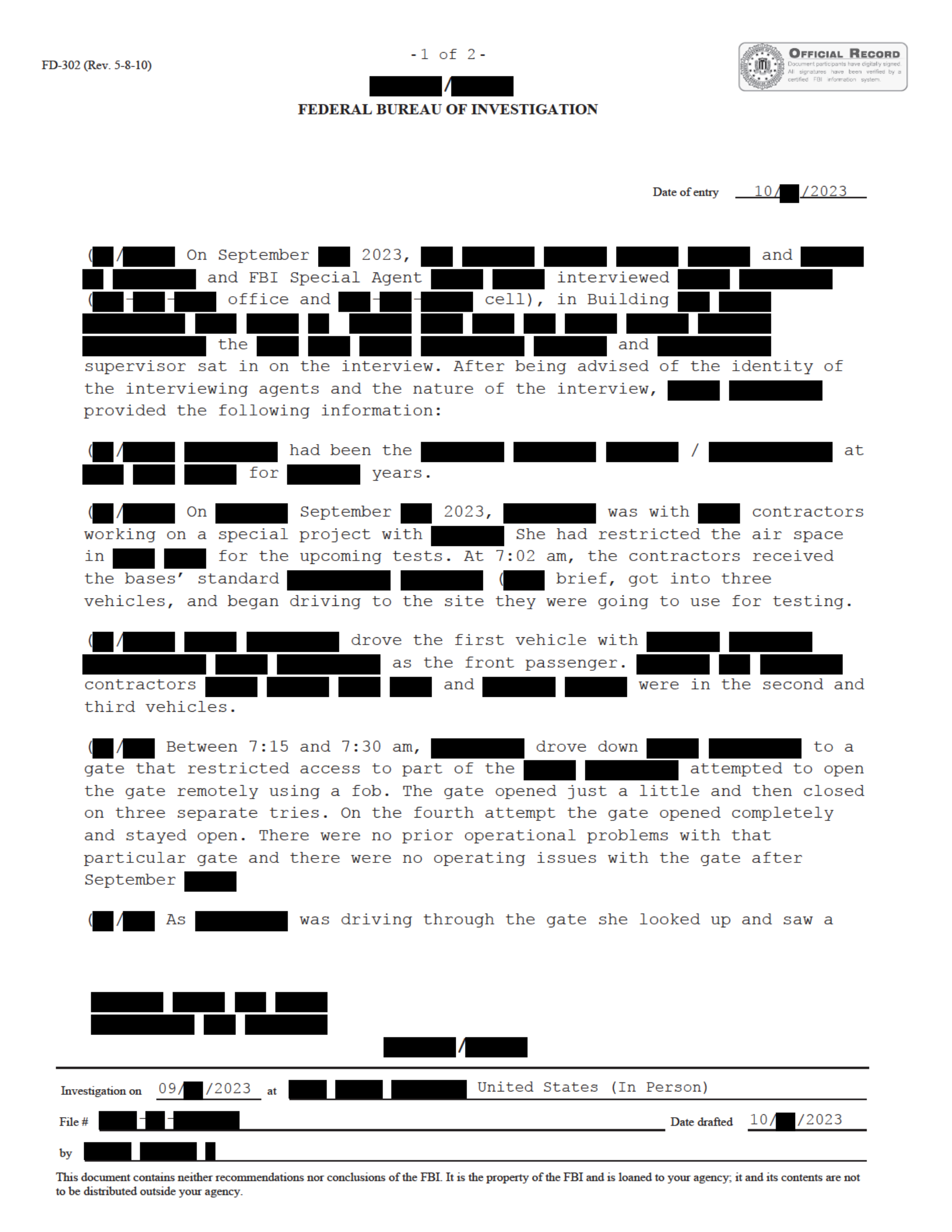
The reason any of that exists in writing is that the FBI took it. Agents interviewed the witnesses in October 2023 and wrote them up on Form FD-302, the Bureau’s standard report of interview. And at the bottom of those 2023 pages sits a paragraph worth reading word for word against the one Byrnes signed in 1964. The document, it says, “contains neither recommendations nor conclusions of the FBI. It is the property of the FBI and is loaned to your agency; it and its contents are not to be distributed outside your agency.”
It is the same sentence. Not a paraphrase, not a descendant. The identical custody language, on an FBI report of a credible witness and an object that should not have been there, fifty-nine years after Byrnes drove out to the arroyo. The Bureau was documenting the same kind of report, asserting the same ownership over it, and loaning it out under the same restriction, in 2023 as in 1964.
That is the continuity made literal. Not a theme I am imposing on two cases. The same custody stamp, the same act of an agent committing a witness’s account to a federal file the Bureau controls. The channel Hoover opened in 1947 was still open in 2023, fifty-four years after the Air Force told the country the government had stopped looking.
Why It Matters
The disclosure conversation files the FBI’s role under trivia. A famous Hoover note, a few yellowed memos, a cabinet nobody opens. The record describes something far more durable than trivia.
The function the Air Force was ordered to perform in 1947, collect the reports, evaluate them, route them, and keep the serious internal record separate from the public posture, did not stay in the Air Force and it did not stop when the Air Force said it had. By 1948 it had branched into the Army and the FBI. By 1964 the FBI was running it as independent field practice, with its own permanent file, its own agents at landing sites, its own custody rules, while four agencies converged on a single arroyo as routine. In 1969 the visible program was closed with a press release. And in 2023 the Bureau was still doing the work, on the same form, under the same custody stamp, for an object over a restricted military range.
That is a single institutional capability operating for seventy-six years, across at least three federal agencies, surviving the public shutdown of the one program citizens were allowed to watch, feeding a records system the public was never structured to reach. Capabilities that run that long and that quietly do not run on inertia. They run on a legal framework that instructs the institution to keep collecting, keep filing, and keep most of it out of public hands. That framework is the one this series has traced back to the Atomic Energy Act of 1946 and the contractor special access program structure built on top of it.
The constitutional question is not whether Lonnie Zamora saw a craft, or whether a contractor saw one in 2023. It is whether a reporting and classification capability that has run without interruption since 1947, across agencies, through the announced death of its own public face, into a system Congress cannot fully reach, has outgrown the Article I oversight that is supposed to govern it.
An FBI agent measured the marks in the dirt at Socorro in 1964 and signed his name to the man who saw them. The Bureau filled out the same form, under the same stamp, for the same kind of report in 2023. The Air Force told the public it was finished in 1969 and the file stayed open the whole time. The instrument has not changed in fifty-nine years. The open question is who, in all that time, has been cleared to read what the Bureau has been keeping.
Stay sharp.